Showing posts with label Introduction to ..... Show all posts

Saturday, July 18, 2009

Introduction to .... Banks, Vendors and selling at the auction house

If you're like me, you've run out of money once or twice and have taken to selling found items for cash to train.

Now that I've advanced a few levels in crafts and skill, I have a new way to make money, Auction House.

I've been lucky enough to advance from Linen Cloth to Wool Cloth for my first aid needs. However, some of the recent monsters I've been fighting have been dropping linen cloth. As always, I pick up everything. Money is money right?

Keep an eye on your items. If it's gray, chances are you wont make much money for it and should sell it at the vendor. If it's soulbound, it's also going to be sold at the vendor - soulbound items cannot be auctioned.

Where auction houses come into play are items that are hard to find... especially things people will be need to level a craft. There are many players who don't consider leveling cooking or first aid until they are well past the areas where they can naturally gather the items as they go. Linen is especially popular, it can be used for early level first air or tailoring.


If you've found your local bank, you can hold items here until you are ready to try and sell it. Each bank you visit will give you all of your items, in the same way that any bank teller of a live bank will give you access to your account.

Items sell best when they are in their largest stack. Linen, for example, stacks in piles of 20, while stringy wolf meat (for level one cooking) stacks in piles of 10.

Here is my formula for sale.
First, check your item. Is it possible or suggested to sell at the auction house? If it is, go back to a vendor and find out how much you could sell it for and make a mental note. Then go to the auction house and search for that item. Are they selling higher or lower for the item in question.

If it's lower, you might as well sell it at the vendor and make some extra cash.
If it's higher, make a note of what the auction rate range is and make an auction for that price or slightly lower/higher. It takes practice to know, but some items will sell even if the same item is already selling for lower. This is mostly true with crafting items because people trying to level will buy several stacks at once.

You are given the option to add a buy out rate. Often, this is what I'll go by when I set my price, especially for craft items. People who are buying craft items usually don't want to wait (hence the buy instead of farm for the items), so they will often use the buy out. Keep that price in mind as you create auctions.

A final note about auction items before I give a live example. If you try and auction it once and it doesn't sell, check the market before you try it again. Sometimes the prices have come down drastically, leaving your item too high for buyers to consider. Also look at the deposit amount. Is it worth putting up that deposit again, and possibly loosing it again, or would you be better to sell at the vendor and make your cash back.

Now, a few live example.

A stack of 20 linen cloth today would sell at 2 silver 60 bronze at a local vendor.
Checking the auction house, the lowest sell rate is a buy out of 55 silver, and as high as 20 gold (why someone thought they could sell for 20 gold when there are at least 15 auctions at a lower rate, I don't know)

In this case it is WELL worth my investment to sell at the auction house, as I could easily make 50 silver more than I would at a vendor. I think I'll make my auction for the lowest rate of 55 silver. The market seems a bit flooded and I don't want to be left at the high end of the market place.

An example of how things change quickly: Yesterday I created an auction for 20 linen and the market price was 1 gold. As I check my auction at the moment there are no bids for this stack, most likely because the market has dropped to half of that rate.

You can cancel an auction and reduce it's auction price, but you will loose your deposit. It's on a case by case bases if its worth it. In this case, it might have been OK to continue on the auction, hoping that someone would buy it, but I will make better money loosing the auction fee and starting again.

A second example are a pair of mystic slippers I found while hunting. The auction house will attempt to sell them for 2 silver, or buy out for 3, but I could sell them, guaranteed to the vendor for 3 silver. As there is already a set of these boots on the auction block, and the chances of two people wanting to buy the same boots are slim, I'll sell them at the vendor and make the guaranteed cash.

My third example is for legs in the monkey family. I mentioned families of armor in my attributes post. Knowing you get an attribute boost if you collect all of a families set, I wonder if someone is looking for these legs of monkey. When I check my vendor, they would buy them for 1 silver 19 bronze but there is no current auction house rate. When I created the auction, I was told the auction deposit (which is non refundable) is 30 bronze, so I figured that into my price, and put them up for auction at 1 silver 70, with a buy out at about 2 silver. If someone wants them, I'll still make a little money, if not, well, then I loose 30 bronze in the transaction.

Knowing your items is key. I had several other green armor items that I sold directly at vendor, knowing that if there is already an auction to compare them with, it is unlikely that two people are looking for the same item.

Bottom line, Auction house is a great place to sell items in demand (like jewels, rocks, minerals, herbs and skins for crafting) and items that are hard to find, but check your profit and loss before you post... sometimes its better just to sell to a vendor.
Read more!

Wednesday, July 15, 2009

Introduction to .... Dungeons


Location: Orgrimmar
Level: 15
Latest Achievements: "Ragefire Chasm" + "Journeyman in First Aid" + "Professional Journeyman"
Total Quests Completed: 55


*New to WoW?*: heavy post.

As noted before, I picked up a few quests that were 15D for Ragefire Chasm. If you ever pick up a quest with (dungeon) bracketed beside the quest name, you know it's a harder quest than usual.

Dungeon quests usually require 3-5 or more people of the level suggested. If you have one such quest and wish to accept it's challenge while still at the suggested level, the best thing to do is select the "looking for group" button from your task bar or write in the /general chat log, explaining what you need.

Sometimes this works. Sometimes you might get an offer from a high level player who will walk you through it for a tip (they want $$) or sometimes you don't get any response. Important to note... the experience you gain is directly related to the level difference between you and the level of the most experience player. You will get more experience if you run an instance with people of your own level.

Once you get a pick up party you need to decide a couple of things before you set off.


Here is the Blizzard Official page on Parties for more information.

First, how do you want the loot to run.
There are several choices here.

Free for All: Anyone can loot any body, it all depends on who gets there first. Fair if you are running an instance with a high level player and all of the loot is going to you.

Round Robin: The kills rotate, giving each member of the team a chance to loot before the first player gets a second go. Fair for even level parties.

Master Looter: Only the group leader can loot - A good idea if there may be disputes about the fairness of the drops.

Group Loot: Same as Round Robin, but when you find an Uncommon (green) or rare (blue) item you have the option of roll a need or a greed for it or skip it. If your a Druid, for example :) and an uncommon staff comes up you can roll need (if it's an upgrade for you). It's the practice of most, unless you really do need it, to roll greed rather than skip. Need will always win out over greed so if no one in your party does truly need it, the highest greed roll wins the item. - Best for low level parties.

Need before Greed: Same as Group Loot, but only players who can use the item are given the chance to role. For example, if an uncommon Gun came up and you were untrained in gun combat, you cannot role for it. - Good for very high level parties where there are many people participating.

Consider an item before you role Need. Some items, mostly blue, are soul bound to you the moment you put it into your pack. If that is the case and you rolled need in error, you cannot remedy the situation by a simple trade back. You will always be given a notice of a soul bound item before you accept to loot it.

The second thing you need to consider is who will be playing which role during the party run. This is not such a problem if you, a Druid, are running a party with a Hunter (Ranged attacks) and a Warrior or Paladin (Melee Combat). In that case you can easily play the healer role, no one in your party can help the others in that regard.

It would then be your job to focus on keeping your other party members healthy. If you are healing, your main focus will be the member playing the melee role. They always take the most damage.

But consider the example: You are running with a Priest and a Hunter. The priest is also a healer, but your party does not have a melee player. You may help your party best in bear form as a damage dealer.

In that case, you are the primary damage dealer and it is your sole job to kick butt. Unless your healer is dead, it is not your responsibility to swap out to Druid casting form to heal yourself. It is your job to keep your enemy focused on you.

Of course, once the fight is over, if your healer needs a hand, you can help that way.

Talk about it with your group and find out who's doing what before you start.

If you are are ready to go, here's what to expect.

A dungeon, or instance as it is more often called, is just that. When a party enters through the swirling gate, they enter into an instance of that area. Only your party members can enter that instance and only you will be permitted to snag the loot that drops.

In a dungeon, 3 or more players are suggested because of the Elite status of the monsters found inside. The goodies dropped are better than normal status, many greens and some blues, but the enemy become harder to bring down.

Communication is key. Talk about who you are targeting before you move forward. Monsters in instances take a much (much) longer time to regenerate so if you clear as you go, you have very little to worry about from behind (though there are some walkers who you need to keep an eye out for)

Make sure you make your way through the whole instance as well. Often times you will find a quest to pick up or hand in. In almost all cases, killing the final boss gives you a great drop (I got a pair of wrist bracers with +2 Intelligence and +2 Spirit, for a Druid that's great). I also completed both of my quests, had enough experience to level into 15 and got an achievement for killing all of the required bosses in Ragefire Chasm.

*My Notes*: Empty your packs out of all but exactly what you'll need to fight. If you're healing, bring along extra water and dump everything else in the bank.... You'll be getting a lot of good stuff and you don't want to see "inventory full" just as you're ready to loot your awesome new armor piece.
Read more!

Monday, July 13, 2009

Introduction to .... Armor Attributes


Location: Crossroads
Level: 14
Latest Achievements: "Journeyman in First Aid" + "Professional Journeyman" + "Complete 50 quests"
Total Quests Completed: 53


I thought it would take a lot longer for me to find a green (uncommon) or blue (rare) weapon or piece of armor. It did not. I've never been good with Attributes - I'm still guessing with 'hunter' - so I had to research it for the blog. (Then again most of the readers (readers.. are there any) already know about these attributes).

Attributes change as you develop in the game. What I need for soloing levels is not going to be the same as what I need when I want to specialize in healing or combat for end game raids.

For us early Druids, I believe a good mix is best. I'll be looking for the following (in the following order, I believe):

Intellect - Which increases our mana points and the chance we will score a critical hit.
It also, and I did not realize this, increases the speed at which we learn weapon skills.

Spirit - Which increases our health (except in combat) and mana regeneration.

Spell Power - To, well, increase spell power.

Strength - Which adds to our melee damage when we are in Animal Form.
Also good to know, Strength provides twice the attack power of Agility while in Cat form.

Agility - Which adds to our armor and our melee damage when we are in Cat form. This is kinda nuked by Strength as a single strength point gives twice the attack power as a single agility point, though, still good if you're looking at it for the armor.

Stamina - Adds to our health meter.
Also, and I didn't know this so copied directly from WoW Wiki

Heart of the Wild (Feral, tier 6) provides a +4% bonus to stamina in bear form per talent point, max 5.

In Dire Bear Form and feral specked, gain the following percentages to stamina: 25% (bear form), 20%, and 6% (Survival of the Fittest), for a total of 15.9 health per stamina. With Blessing of Kings, it jumps to 17.49 health per point of stamina.


Interesting, no?.. meaning, if you choose mostly talents from the Feral Combat talent tree, it is less likely you will need Stamina attributes if you decide to learn the talent 'survival of the fittest' and 'blessing of the kings', unless you plan to talent up for an end game attack dealer, then health will be your best friend and you can use everything you can get.

A good mix at the lower levels will be most beneficial, but if you want to specialize in spells or attack power, you can of course, lean heavy on the magic or the melee side of things. WOW is nothing if not diverse.

Also, if you are looking at attributes, sometimes your attributes will out rank your armor. Say, for example, I had a pair of boots that were 'armor 8' (very low level, I know) and found a replacement pair that are 'armor 7 +intellect 2', I would take the armor 7.

I read somewhere, appologies, I forget where, if you find an entire set of a family of armor, you get a boost. If you're searching for them, Druids should look for armor that is in the "of the Falcon" family, for Intellect and Agility, or "of the Gorilla" family for Strength, Intellect. I personally pick Gorilla, but there are so many other families out there.

Here is the official blizzard page for attributes.
Read more!

Thursday, July 9, 2009

Introduction to .... Addons, Quest Helpers and Thottbot


Location: Thunder Bluff
Level: 11
Latest Achievements: "Journeyman Cook" + "Achievement Level 10"
Total Quests Completed: 35


When I first started out in WoW with my first character (also a hunter, but not my 'hunter') I was puzzled by how players found the location they were going so easily. Reading the quest log book ('L') was not always helpful.

Then I was introduced to the world of Quest Helpers. There are many around and they are easily found if you google. I have heard a lot of praise for one titled (funny enough) "quest helper", but the one I was suggested to use is "Carbonite" from Carbonite.Com.


Carbonite, for example, displays on the world map where to find items required for your quest. Locations show as a transparent color block over areas where the monsters or items can be found. It also provides an on screen list of all the quests you have accepted and what level can safely complete said quest. Unlike our blizzard quest logs, which only display a color code system, Carbonite, for example, gives a number.

It is very customizable. I have mine set to show on screen the quests in the order of closeness to me as well as only quests in the zone I am in. I also still require my blizzard quest log to read exactly what I need to do and what items to use to complete the quest. (Like the level 5-10 water cleanse quests)

What ever you choose, Quest helpers are a wonderful tool in the game if you choose to use them. They are in no way manditory. Have a look at what is available and make that choice for yourself.

Quests Helpers come as Addons. There are also many other addons you could choose to help you and customize your screen. Anything from craft helpers to hate ratings.

One final note here is for helper websites. My favorite is Thottbot, but there is also a WOW Wiki for every occasion as well. Again, websites like this are great helps if you are totally stuck. I live from them, but you can make that choice yourself.


Current Statistics: *unchanged from previous


Defence : 55
Mace: 55*
Staves: 55
Unarmed skill: 54 *
Cooking: 62/150
First Aid: 39/75*

Strength: 34
Agility: 22
Stamina: 31
Intellect: 29
Spirit: 38
Armor: 296
Read more!

Tuesday, July 7, 2009

An Introduction to .... Talent Points


Location: Thunder Bluff
Level: 11
Latest Achievements: "Journeyman Cook" + "Achievement Level 10"
Total Quests Completed: 35


Before I branch out into Thunder Bluff and take the first Druid training, I think now would be a good time to introduce you to your Talent Tree, a selection of additions to your spell base you can access only after you reach level 10. Talents are a further way to diversify your character from everyone else in the game. They are a personal choice based on how you would like you play the game. Your talent tree is accessible through your menu or by pressing 'n'. (I don't know why 'n', it just is)

As a Druid, our talents are divided into three branches.
Balance, Feral Combat and Restoration.


Have a look through each of the different skills you can learn through each tree. You will notice they are divided. I am far from an expert in talent trees, but we'll learn together.

Some people I speak with say its best to limit yourself to one speciality. If you want to improve your damage through magic, stick with Balance, to increase your damage through your different images (Bear, Cat etc) pick Feral Combat, or if you want to boost your healing, go for Restoration. Personally, and talents should be a personal choice, I am going to branch out and choose talents from any tree I choose, based on what looks best at the time.

There are two things I can tell you about Talent Trees.
1) They are not written in stone. If you want to unlearn a talent, you can, but it will cost you. Each time you choose to un-learn, you will need to pay an increased fee.
2) Each branch is stacked. You need to have learned the lowest branches on the pole before you can stretch to the highest. You'll notice that when you mouse over a talent, it will give you a description as well as the requirements you need before you can learn that talent.

You receive 1 talent point for each level you achieve after and including level 10. When I stacked 'hunter's' talent points, I chose to stay in one single branch and to this point, though I have reached level 75, I have yet to reach enough to complete a single tree. Not knowing about Druid trees, this may be the case here as well, though the tree looks a lot smaller than 'hunter's'.

So, if you've reached level 10, have a click into your talents and see what looks best to you. For me, I chose Starlight Wrath from the Balance category (to reduce cast time of my Wrath spell) and 'Improve Mark of the Wild' from the Restoration category (to increase the effect of that spell). They looked the best from the choices I was given, based on the way I personally play the game.

A few notes: I just noticed that on Blogger you have the ability to make a post but not publish it until a set date. Rather than flood my blog as I did with my day one (levels 1-10) adventures, I may, in the future, decide to use this to slow the posts. That will be based on who is following the blog and how much people want to read at a single time. Leave me a comment with your opinion.


Current Statistics:


Stave, Mace and Defence skill: 55 each (max)
Unarmed skill: 54 (that elusive last point was killing me)
Cooking: 59/150
First Aid: 39/75

Strength: 31
Agility: 20
Stamina: 28
Intellect: 26
Spirit: 35
Armor: 214
Read more!

Monday, July 6, 2009

Starting out Druid - Level 1-5


Location: Bloodhoof Village, Mulgore
Level: 4
Latest Achievements:
Total Quests Completed: Uncounted (continued to level 10)


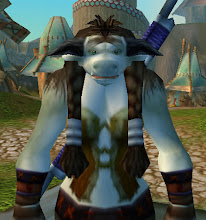
This week marks my first steps into the role of Tauren Druid.

As I said in the opening of this blog, I want to catalogue my journey as a Druid, but I also hope to help new comers to the game. For you more experienced players, don't laugh too hard at the *New to WoW?*: comments. I'm sure many of them are covered in the manual, but who actually reads that? The comments under *My Notes*: are just that. Things I've found helpful. Not a requirement to play the game, but things to consider.

A Tauren starts out much the same as any other melee (hand to hand) combat character. As Tauren, we begin in 'Red Cloud Mesa', with many of the same opening quests as other classes.

*New to WoW?*: Talk to anyone with a '!' above their head. When you complete the quest they have given, the'!' turns to '?'. A '!' means you are too low of a level to accept their quest (wont see them for a while) and '?' means you have accepted, but not completed the given task.


*My Notes* :Take a tour of the small village and get acquainted with where your vendors and trainers are. This is true of this village as well as all to come. Also, I find it helpful to collect all open quests in the village before setting off.

Personally, being used to ranged 'hunter-style' fighting, quickly learned I was not required to chase down each animal. Wrath took care of my pull and then I was free to combat as I expected. I also quickly learned my healing touch button.

*My Notes*: Pick up EVERYTHING. I know the packs are small, but pick up as much as you can [don't accidentally throw out a quest item though, I've done that :) ] and invest in a larger one as soon as your cash flow allows it. In my travels, kills dropped enough small 6 slot bags to fill my open spots. Bag space is very important when you get to the next village and at all times after.

Completing the opening quests was nothing too challenging. (Watch out for the Hogmen of Brambleblade Ravine though, they agro in mobs) After the first few quests you should be experienced to level 2. Don't forget to visit your Druid trainer to receive Mark of the Wild and what ever else she teaches. (even writing about it the day after, I have already forgotten). If you don't have enough cash yet to train, go kill some more beasts and sell what they drop. You can always train at the next village, but keeping up to date is, in my opinion, better.

*New to WoW?* : Just continue running quests for people until you no longer see the '!' Above their heads. At some point a quest giver will send you on a run that involves speaking with a person at the next stop. Finish up what you have going here, then go see that person.

Druids are automatically trained in Staff and Club. While I was in Red Cloud Mesa, I purchased a cheep club from the vendor and, before leaving the area of level 1 and 2, leveled up my Staff, Club and Unarmed skills to their max. This way, later in the game, if a wonderful Club drops off a kill, I will have the skill level up high enough to make using it worth-while.

*New to WoW?*: To skill up your 'unarmed', open your character screen and drag your staff or club into your pack. To re-arm, preform actions in reverse. To see how skilled you are, open the Skills tab found in your character menu. Unarmed will come in handy if you're ever out in the middle of no where and your staff or club breaks to red.
Read more!

Introduction to .... This Blog

Welcome to Mulgore and Beyond. A weekly (and possibly more) blog about WoW and more specifically a Tauren Druid.

I'll get right to it, but first, a little background on me and why I decided to blog about my Druid Life.


I started playing WoW, my first RPG, in May 2009, when I created a Blood Elf Hunter. In the following two months, I leveled 'hunter' to near end-game (at this point I'm 74). Soon after I reached the area of Burning Crusade I got the feeling I had missed a lot in my quest to reach 80, which became 100% clear when I set off to find particular dungeons and found there were whole areas I had skipped over.

I love playing 'hunter' and have since gone back and leveled things like crafts and cooking, but have also decided to make myself an alternate character, Milyssa, my Druid, where I will move through areas, reading and experiencing everything as if I've never played.

In writing 'Mulgore and Beyond' I hope to record my Druid Life from the start. I welcome readers: anyone who is new to WoW looking for guidance or experienced WoW players who want to read about Druid experiences and/or laugh at the many mistakes I am sure to make along the way.


I am in no way an expert, but its possible that in reading my blog, you may save yourself the back tracking that I am now doing with 'hunter'. You may also learn something with me along the way. I've decided to play this character, Milyssa, only 1-2 times a week, so not to totally neglect 'hunter'. I will be writing about what I've accomplished on those days. Some times it might be a quest day, some days craft. Some days both. Remember: I am moving at the speed of snail, gaining the most out of every area before I move on. I am also far from an experienced gamer. Please be kind when leaving comments, but comments are welcome!
Read more!